
If you ask ten WordPress site owners which SEO plugin to use, you will get two answers: Yoast SEO and Rank Math. Together they run on well over ten million sites, both have free versions, both have paid upgrades, and both promise to help you get found in search. So what is the real difference, and which one should you install?
This comparison uses the plugins' own WordPress.org listings, feature lists and pricing pages, checked on 5 November 2026, and keeps opinions separate from facts. We have not benchmarked either plugin on a live site, so you will not find speed claims here; instead you will find what each one includes for free, what you pay for, and how to decide.
First, what an SEO plugin does (and does not do)
An SEO plugin handles the technical housekeeping that search engines like: page titles and meta descriptions, XML sitemaps, canonical addresses to avoid duplicate-content confusion, breadcrumbs, social sharing previews, and structured data (schema) that helps search engines understand what a page is. It also gives you in-editor guidance while you write.
What it does not do is rank your site. No plugin can make thin or unhelpful content rank, and neither plugin's green light means a page will perform. Treat the scores as a checklist for the basics, not as a grade for quality. The best plugin is the one you will actually use consistently.
At a glance
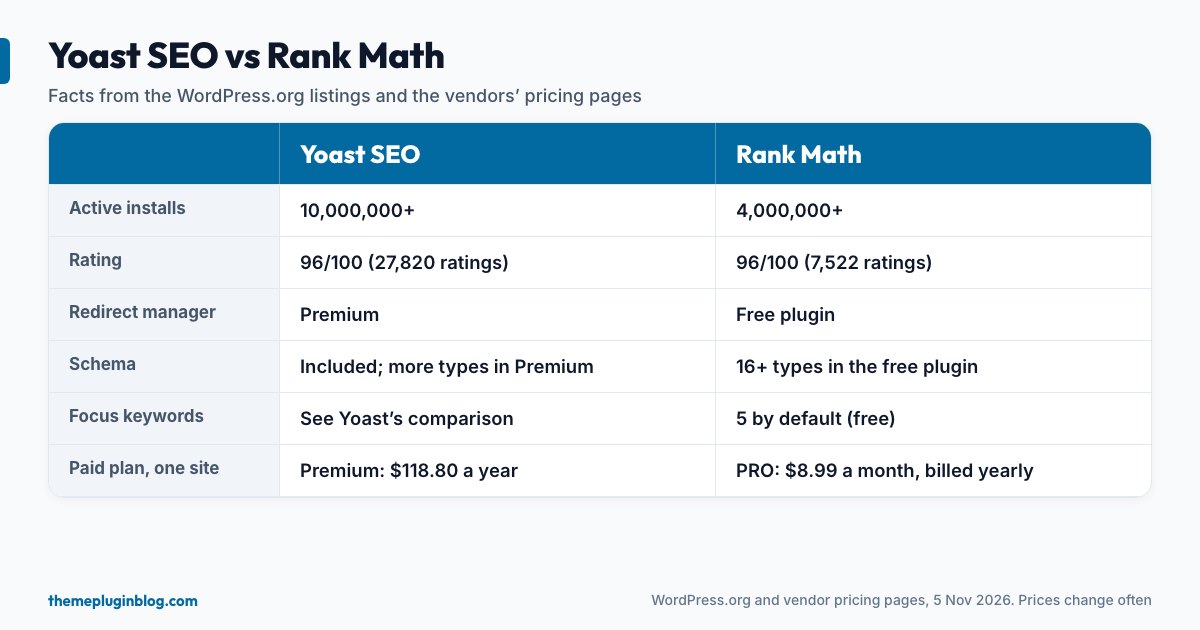
| Yoast SEO | Rank Math | |
|---|---|---|
| Active installs | 10,000,000+ | 4,000,000+ |
| WordPress.org rating | 96/100 (27,820 ratings) | 96/100 (7,522 ratings) |
| Current version | 28.8 (updated 27 Oct 2026) | 1.0.281 (updated 3 Nov 2026) |
| Redirect manager | Premium | Included in the free plugin |
| Focus keywords per page | Check Yoast's free vs Premium comparison | 5 by default in the free plugin |
| Paid plan, one site | Yoast SEO Premium: $118.80 a year | PRO: $8.99 a month billed yearly (about $108 a year), often discounted |
What Yoast SEO gives you
Yoast has been around since 2008 and is built around a simple idea: real-time guidance while you write, in a "traffic light" system of red, orange and green. The free plugin covers the essentials:
- Content and readability analysis in the editor.
- Automated meta tag optimisation, canonical URLs and advanced XML sitemaps.
- Schema.org structured data and breadcrumb control.
- Search result previews for desktop and mobile, plus HowTo and FAQ blocks with built-in schema.
- Crawl settings and llms.txt management for how bots and AI systems read your site.
- A free bulk editor to review titles, meta descriptions and focus keyphrases across the whole site.
Yoast SEO Premium adds a redirect manager (with bulk tools, CSV import and export, and prompts when you move or delete content), internal linking suggestions, social previews for Facebook and X, a bot blocker for AI crawlers such as GPTBot and CCBot, more schema types, and its AI tools. It also bundles the former Local, News and Video add-ons and gives access to 24/7 support. Yoast's pricing page lists Premium at $118.80 a year, billed annually and excluding VAT, following a change that took effect on 1 July 2025 (the previous price was $99). Yoast WooCommerce SEO is a separate plan at $178.80 a year.
What Rank Math gives you
Rank Math is the newer plugin, and its pitch is a long list of features in the free version, organised as modules you switch on only if you need them. According to its WordPress.org listing, the free plugin includes:
- A setup wizard that configures the plugin for your site.
- 16+ schema types for rich results.
- Optimisation for multiple focus keywords (five by default).
- Google Search Console and Google Analytics integration.
- XML sitemaps with custom post type support.
- 30+ SEO tests with one-click fixes, and a content analysis with recommendations.
- A redirection manager, a built-in 404 monitor and internal link suggestions.
- A role manager to control what each team member can access.
- WooCommerce SEO with automatic schema, plus local SEO tools.
- One-click import from Yoast, All in One SEO, SEOPress and the Redirection plugin.
Rank Math's paid PRO plan lists a regular price of $8.99 a month billed yearly (about $107.88 a year) and, at the time of writing, a first-year promotion at $5.59 a month. It covers unlimited personal sites and tracks up to 1,000 keywords; the Business plan ($27.99 a month at the regular price, 200 sites, 20,000 keywords) and Agency plan ($64.99 a month, 750 client sites, 75,000 keywords) are aimed at professionals. Remember that promotional prices apply to the first term, and renewals are charged at the regular price.
The practical differences
Free features that cost money elsewhere
The clearest dividing line is the free version. A redirect manager, a 404 monitor and a broad list of schema types are part of Rank Math's free plugin. With Yoast, redirects are a Premium feature, and the free plugin is deliberately lighter. If you want these tools without paying, Rank Math gives you more for free. If you only need the basics (titles, descriptions, sitemaps, a readability check), Yoast's free plugin does that well and does not ask you to decide on dozens of modules.
Interface and learning curve
Yoast's traffic lights are easy to read, which suits writers and beginners. Rank Math shows a score and a long list of checks, and it exposes many settings you can enable or disable. Some people love the control, others find it too much. A fair way to choose is to install each on a test site and write one sample post with each: which one do you want to open again tomorrow?
AI features
Both plugins now promote AI features, and the details change quickly. Yoast says its AI tools come with Premium, including unlimited use of its AI features (listed as beta on the pricing page). Rank Math offers a Content AI module and describes a free starting allowance, with plans listing starter, creator and expert levels. Treat AI suggestions as a draft to review, not as an instruction to follow, and read each plan's current limits before counting on them.
External services and privacy
Some features in both plugins call outside services. As one example, Rank Math's listing discloses that its keyword suggestions feature sends the keyword you type, and your site's locale, to its API each time you type in the focus keyword field. That is documented and normal for such features, but if you manage a site with strict privacy requirements, read the "external services" section of whichever plugin you pick and switch off what you do not need.
Which one should you choose?
Choose Yoast SEO if you want a mature, widely documented plugin with very simple on-page guidance; you mainly need titles, descriptions, sitemaps and readability checks; you prefer fewer settings; or you plan to buy Premium and use its bundled local, news and video tools and support.
Choose Rank Math if you want more built into the free plugin (redirects, a 404 monitor, many schema types, multiple focus keywords); you like switching modules on and off; you want Search Console data inside WordPress; or you manage several sites and want a plan priced by number of sites.
If you are undecided, either is a sound choice. The difference in results will come from the quality and structure of your content, not from this decision.
How to switch without losing your work
- Back up your site (files and database).
- Use the importer. Rank Math lists one-click imports from Yoast; Yoast has built-in import and export tools for moving data from other SEO plugins. Import titles, descriptions, focus keywords and redirects.
- Deactivate the old plugin after the import, so only one SEO plugin runs at a time. Running both causes duplicate tags.
- Spot-check pages. View the source of a few pages (right-click, View Page Source) and check that each has exactly one title tag and one meta description.
- Re-submit your sitemap in Google Search Console if its address changed.
- Keep the old plugin's data for a week or two before deleting it, in case something did not import.
The bottom line
Yoast SEO is the simpler, long-established choice with strong writing guidance; Rank Math is the feature-rich option that puts more in the free tier. Both have been rated 96 out of 100 by their users, both are updated regularly, and both can be switched with an importer. Pick the one that matches how you work, set it up once, and spend your effort where SEO is actually won: useful, well-organised content.
Sources
Versions, install counts and ratings are from the WordPress.org plugin API; prices are from the vendors' pricing pages. All checked on 5 November 2026 and subject to change. Promotional prices were running on Rank Math's page.